CannabisClergy.com
Guide for medical cannabis ministers
and medical marijuana ministers
This is a Guide for medical cannabis ministers and medical marijuana ministers.
This Guide outlines some of the topics you may need to prepare for in order to have a successful legal defense in both federal (U.S.) and state (California) court for working as a medical marijuana minister or medical cannabis minister in a California medical cannabis collective, dispensary, or cooperative.
Exact material will vary greatly by religion. I provide examples from my own religion, although many of the examples may not apply to your religion. You will want to prepare your own defense, probably with the help of a lawyer skilled in first amendment and criminal law.
important writings
The courts often consider the existence of important writings in determining if a religion is legally valid.
legal standards
“5. b. Important Writings: Most religions embrace seminal, elemental, fundamental, or sacred writings. These writing often include creeds, tenets, precepts, parables, commandments, prayers, scriptures, catechisms, chants, rites, or mantras.” —United States of America v David Meyers
“a literature of its own,” —IRS definition of a church
religious freedom reply to IRS standards
It is unlikely that an ethnic or tribal religion will have “a literature of its own,” as required by the IRS’ ninth criterion. Oral tradition and participation are the means of transferring the religion between generations in such groups. Among the American Indians, there is an “absence of recorded dogma.” One federal court has held that whether a religious organization has extensive literature is not constitutionally dispositive. If relied upon by the IRS, this test would tend to favor more established, traditional, articulate and intellectual churches. — “Defining Religion in American Law” by Bruce J. Casino, International Coalition for Religious Freedom
The ancient Egyptian religion is deeply embedded in Western culture, as well as African, European, Asian, Chinese, and Indian culture. The religion is deeply embedded into the English language itself.
Ancient Egyptian religious writings are the oldest known writing in the entire world. The oldest discovered written character is the ankh, which appears on cliff paintings and cliff carvings that are more than 12,000 years old. With the same meaning as the word ankh still has today.
The Book of the Coming Forth Into the Day (better known as the Egyptian Book of the Dead) provides the most complete description of the afterlife and the path to the afterlife of any religion in the entire world.
Many alphabets are derived from ancient Egyptian writing, including the Roman alphabet, Greek alphabet, Germanic runes, and Arabic alphabet.
The oldest known fiction writing was the story of Cinderella, originally a story about an ancient Egyptian princess.
The Great Library at Alexandria was a temple of Pr Ntr Kmt, headed by a High Priestess of Aset (Isis) or High Priest of Ptah.
Ntr Sentra poem
Mau Bast! Mau Bast! A Basti, per em setat, erta-na chu em asui neter sentra semu hena net'emmit, hetep ab em asui tau heqt.
Translation: Hail Bast! Hail Bast! Hail Bast, coming forth from the secret place, may there be given to me splendor in the place of incense (cannabis smoke), herbs, and love-joys, peace of heart in the place of bread and beer.
scribes
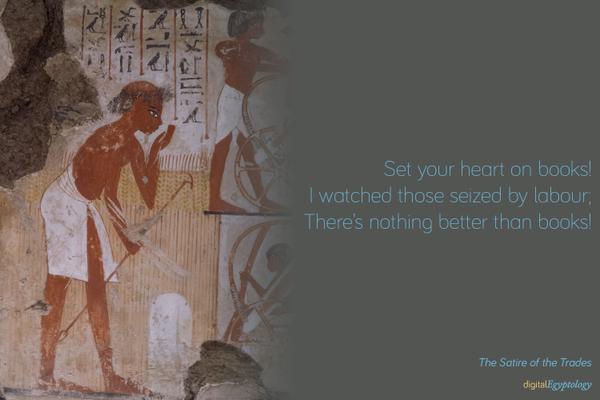
The following passages are from the Middle Kingdom compilation Satire of the Trades, also called The Instruction of Dua-Kheti, written by Tjaru (also called Duau Khety) for his son Pepy sometime between 1950-1900 B.C.E. in early Dynasty 12. This work extolled the virtues of being a scribe and put down other occupations, especially manual labor, with biting satire. The book was used throughout the New Kingdom to train scribes, who copied the pages to learn to write.
“I have seen many beatings …
Set your heart on books!
I watched those recruited for labor —
There’s nothing better than books!
It’s like a boat on the water.
Read the end of the Kemit Book,
You’ll find this saying there:
‘A scribe at whatever post in town,
He will not suffer in it;
As he fills another’s need,
he will not lack rewards’.”
“They gave themselves the scroll as lector-priest,
The writing-board as loving son.
Instructions are their tombs,
The reed pen is their child,
The stone surface their wife.
People great and small
Are given them as children,
For the scribe, he is their leader.”
The courts have already ruled in multiple cases that a person who starts preparing a religious defense (including gathering certificates and other paperwork) after arrest loses all chance to use the late religious defense. It is essential that you prepare your defense before you are arrested. Adequate preparation may even prevent arrest.
This website is concerned with religious matters and only obliquely discusses the law. I strongly recommend that medical marijuana ministers rely on a high quality lawyer.
I (Milo) use my own religion as an example, because this is the religion I know well. I strongly urge people to get together with their lawyer and prepare a similar discussion for their own religion. Again, my religion is only an example.
Good news: Many people over the years have successfully used Pr Ntr Kmt religious cannabis certificates. The author of this website has personally several times over more than a decade shown various police Pr Ntr Kmt documentation and the police have politely returned the religious cannabis. There are at least two Pr Ntr Kmt cannabis ministers who have been released after the police discovered several pounds of religious cannabis (although the police kept the cannabis). There are numerous real world successes.
Reality: If the government decides it wants to “get you”, then your only chance is if you can afford a really, really good lawyer.
The law is whatever the government decides the law is.
The rights you heard about in grade school only apply if you can afford a great lawyer. Public defenders are under-budgeted and only want to process paperwork for plea bargains. They simply don’t have the time or money for trials.
We don’t want to discourage anyone from worshiping with cannabis, but we do want to strongly warn everyone that you have a significant risk of long term imprisonment or worse, especially outside of major industrialized nations.
Please act responsibly. Please hire a lawyer if you can possibly afford to do so.
The courts have already ruled in multiple cases that a person who starts preparing a religious defense (including gathering certificates and other paperwork) after arrest loses all chance to use the late religious defense. It is essential that you prepare your defense before you are arrested. Adequate preparation may even prevent arrest.
Get a Pr Ntr Kmt certificate as proof that your cannabis religion is real.
These web pages contain religious advice. These web pages are not professional legal or medical advice. Nothing on this website should be considered as a substitute or replacement for professional medical, health, or legal advice. All persons should seek the advice of qualified medical, health, or legal providers.
If you spot an error in fact, grammar, syntax, or spelling, or a broken link, or have additional information, commentary, or constructive criticism, please contact Milo at PO Box 1361, Tustin, Calif, 92781, USA.