CannabisClergy.com
Guide for medical cannabis ministers
and medical marijuana ministers
This is a Guide for medical cannabis ministers and medical marijuana ministers.
This Guide outlines some of the topics you may need to prepare for in order to have a successful legal defense in both federal (U.S.) and state (California) court for working as a medical marijuana minister or medical cannabis minister in a California medical cannabis collective, dispensary, or cooperative.
Exact material will vary greatly by religion. I provide examples from my own religion, although many of the examples may not apply to your religion. You will want to prepare your own defense, probably with the help of a lawyer skilled in first amendment and criminal law.
temples
The courts often consider the existence of temples in determining if a religion is legally valid.
legal standards
“5. c. Gathering Places: Many religions designate particular structures or places as sacred, holy, or significant. These sites often serve as gathering places for believers. They include physical structures, such as churches, mosques, temples, pyramids, synagogues, or shrines; and natural places, such as springs, rivers, forests, plains, or mountains.” —United States of America v David Meyers
“established places of worship,” —IRS definition of a church
body as a temple
The government thinks of temples as buildings.
A common religious idea is the body as a temple to the divine.
Rasta
Rastafari views the body as a temple. Therefore, Rastafari are expected to take good care of themselves. You seethis in the ital diet.
Many Rastafari believe that because their bodies are temples, they should let their hair grow long without any unnatural tainting.
Rasta also often refrain from tatooing their skin.
Kemetic or ancient Egyptian religion
pr - temple
The ancient Egyptians used the same word as “house” for their word for temple. This is because they believed that the temples were the actual physical houses of the deity worshipped there.
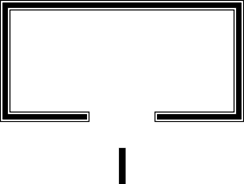
The ancient Egyptian word for “house” is “pr” (shown below). The hieroglyph “pr” is a line drawing of a house’s walls viewed from above. Because the hieroglyph “pr” is used both for the word “house” and for the syllabic sound “pr” are the same character, the ideogram (also called the pictorial sign, drawn as a short vertical line) is placed below the hieroglyph “pr” when the meaning is house rather than just the sound. Context indicates whether the word means an ordinary house or a temple.
hieroglyph for temple
per - temple
The ancient Egyptian word house is also used for temples, which are considered to be the personal house of the corresponding deity.
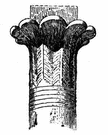
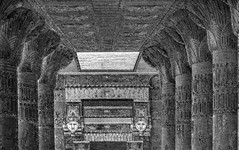
The ancient Egyptians built many of their earliest temples with wooden columns topped with palm leaves. When the Egyptians switched to stone columns they continued to carve palm fronds and leaves into the tops of the columns (see example below).
illustration of temple columns and ceiling
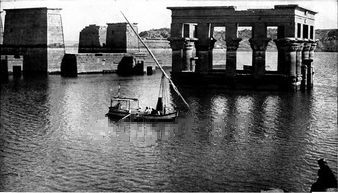
submerged temple at Philae
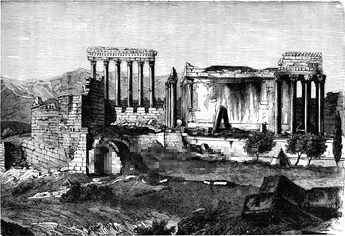
Baalbec ruin
Great Temple at Ephesus
The Great Temple at Ephesus, one of the Seven Wonders of the World, was dedicated to Bast (called Artemis by the Greeks and Diana by the Romans). Women from all over Africa, Europe, and Asia (from as far away as China) came to the Great Temple at Ephesus and brought gifts from their homelands. The Christian writer Paul specifically congratulates Ephesian Christians on their vandalism (including destruction of art and burning of books) at the Great Temple of Ephesus.
The statue of the Lunar Goddess at the Great Temple of Ephesus depicts the Goddess holding a large number of Easter eggs (although some claim they are bull testicals).
Great Library at Alexandria
The Great Library at Alexandria was a temple of Pr Ntr Kmt, headed by a High Priestess of Aset (Isis) or High Priest of Ptah.
converted temples
In the 300s and 400s the Christians in control of the Roman Empire forcibly converted hundreds of temples of Isis into Roman Catholic and Orthodox Christian churches.
The courts have already ruled in multiple cases that a person who starts preparing a religious defense (including gathering certificates and other paperwork) after arrest loses all chance to use the late religious defense. It is essential that you prepare your defense before you are arrested. Adequate preparation may even prevent arrest.
This website is concerned with religious matters and only obliquely discusses the law. I strongly recommend that medical marijuana ministers rely on a high quality lawyer.
I (Milo) use my own religion as an example, because this is the religion I know well. I strongly urge people to get together with their lawyer and prepare a similar discussion for their own religion. Again, my religion is only an example.
Good news: Many people over the years have successfully used Pr Ntr Kmt religious cannabis certificates. The author of this website has personally several times over more than a decade shown various police Pr Ntr Kmt documentation and the police have politely returned the religious cannabis. There are at least two Pr Ntr Kmt cannabis ministers who have been released after the police discovered several pounds of religious cannabis (although the police kept the cannabis). There are numerous real world successes.
Reality: If the government decides it wants to “get you”, then your only chance is if you can afford a really, really good lawyer.
The law is whatever the government decides the law is.
The rights you heard about in grade school only apply if you can afford a great lawyer. Public defenders are under-budgeted and only want to process paperwork for plea bargains. They simply don’t have the time or money for trials.
We don’t want to discourage anyone from worshiping with cannabis, but we do want to strongly warn everyone that you have a significant risk of long term imprisonment or worse, especially outside of major industrialized nations.
Please act responsibly. Please hire a lawyer if you can possibly afford to do so.
These web pages contain religious advice. These web pages are not professional legal or medical advice. Nothing on this website should be considered as a substitute or replacement for professional medical, health, or legal advice. All persons should seek the advice of qualified medical, health, or legal providers.
If you spot an error in fact, grammar, syntax, or spelling, or a broken link, or have additional information, commentary, or constructive criticism, please contact Milo at PO Box 1361, Tustin, Calif, 92781, USA.